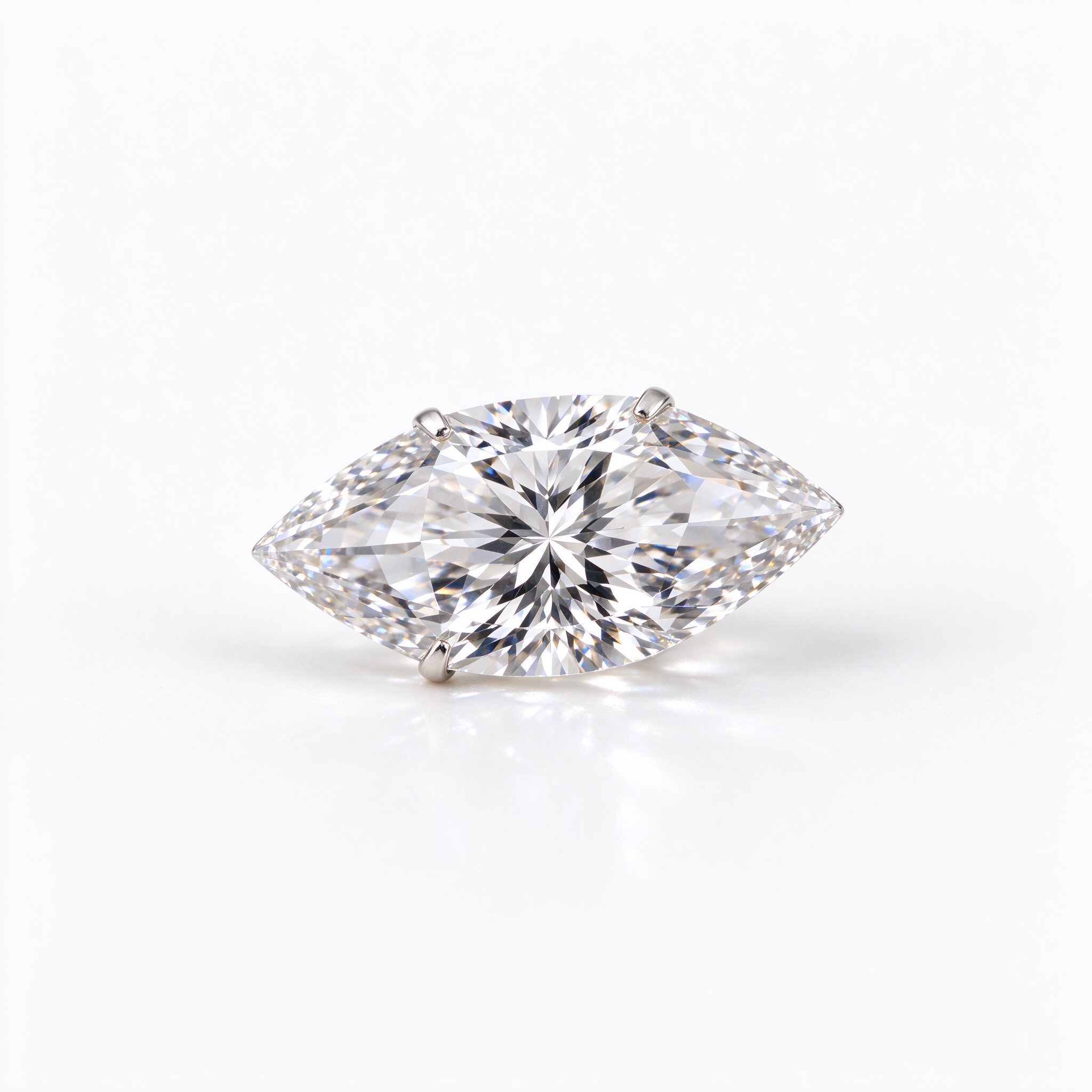
If a customer walks in asking for "the biggest-looking stone for the money," our bench often points them to a marquise. It is the longest shape we cut, a tapered boat with pointed ends that stretches across the finger more than any other cut. Marquise moissanite delivers maximum face-up size from a modest carat, which is exactly why it has a loyal following. This guide explains how it works and what to inspect so the large look is matched by clean sparkle.
Why the marquise looks bigger
A round concentrates its weight in a compact circle. A marquise spreads that same weight along a long axis, typically 1.8 to 2.2 times as long as it is wide. The eye follows that length, so the stone reads dramatically larger on the finger. A 1ct marquise can visually compete with a 1.5ct round in photos and on the hand. For budget-conscious bridal buyers, that perceived size is the whole appeal.
Length-to-width ratio: the key number
A marquise's ratio decides both its look and its behavior. Around 1.8:1 to 2.0:1 is the classic balanced range. Below 1.7:1 it looks fat and almost like a pointed oval; above 2.2:1 it becomes extremely narrow and the tips are prone to a dark bow-tie. We cut to the balanced window and QC the light return, because an over-stretched marquise can look thin and lifeless.
The bow-tie risk
Because both ends are pointed, the marquise is the shape most likely to show a dark bow-tie down the center if cut shallowly. When you receive marquise stones, inspect them face-up on a white tray under a lamp, just as we do. Even light return across the whole boat is the goal. A visible dark band means a poor cut, regardless of price. We cover this check in detail in our proportions and bow-tie guide.
Setting the marquise safely
The two pointed ends need V-prongs or a bezel to prevent chipping. Naked marquise tips catch on clothing and knocks. For rings, a cathedral setting or halo also protects the tips. When you order marquise like our 1ct marquise, let us know the setting type so we select a stone with a sturdy girdle and tip. As side stones, a pair of marquise flanking a round center is a timeless look.
Marquise in your assortment
Marquise is not a daily-volume shape, but it is a high-margin, high-impulse one. It sells to customers who want a vintage cocktail look or maximum finger coverage. We suggest carrying a 1ct and a 2ct marquise, plus a matched pair for side-stone work. See the full range in the marquise collection. For how it compares with pear, read our pear vs marquise comparison.
Quick FAQ
Does marquise suit all hand shapes? It elongates shorter fingers well; very long slender hands also carry it elegantly.
What color for a marquise? D-F for white metal, because the long face shows any warmth.
Is it good for daily wear? Yes, once the tips are protected with V-prongs.
Why marquise is a photo favorite
The marquise photographs dramatically because of its length. In a flat-lay or on-hand photo, the long axis draws the eye and makes the stone look larger than its carat. This is why marquise engagement rings perform well on social media and in lookbooks. If you sell online, photograph the marquise from above to show its full length. Just be honest about proportions: an over-stretched marquise can look thin in person, so stick to the balanced ratio we recommend.
Marquise as side stones
A less obvious use of marquise is as side stones. Two tapered marquise flanking a round or emerald center is a classic three-stone that adds length without overwhelming. We sell marquise pairs specifically for this. Because the sides need to match, order both from the same batch. Browse the marquise collection for the 1ct and 2ct stones, and ask for matched pairs on the custom cut page.
Who should avoid the marquise
The marquise is not for everyone. Customers who want a safe, classic look should choose a round. Customers with very active hands who never remove their rings may prefer a shape with fewer exposed tips. But for buyers who want maximum presence and a distinctive look, the marquise delivers more face-up size per dollar than almost any other cut. Compare it with the pear in our shape comparison.
Why the marquise is a statement, not a daily
The marquise's drama is also its limitation. It is a statement shape, not a quiet everyday shape. Customers who buy it usually want people to notice. That means it sells well as a cocktail ring, a vintage piece, or a bold engagement ring. It is less suited to someone who wants understated. Position it correctly and it sells itself. Compare it with the softer pear in our comparison.
Sizing marquise for maximum presence
Because the marquise is long, even a 1ct stone reads large. Do not oversize it; an over-long marquise looks thin. Stick to the balanced ratio we recommend and the shape reads elegant, not stretched. We stock the 1ct and 2ct in that window, visible on the marquise page.
Ordering a marquise that looks huge but balanced
To get the large look without the thin look, stick to our balanced ratio. Tell us you want maximum finger coverage, and we will cut to the window that keeps the tips bright. Inspect the sample for bow-tie before bulk. The marquise range shows the standard sizes, and custom ratios go through custom cut.
Making the marquise work for your margin
The marquise's large face-up look is its commercial power. Customers who want a big-looking ring at a modest carat are exactly who buys a marquise, and they are usually less price-sensitive because they are chasing a specific look. Price the finished piece as a statement design rather than a loose stone markup. This protects your margin. We cut the marquise to a balanced ratio so the large look does not come with a thin, lifeless stone.
If you are adding marquise to your line, start with a 1ct and a 2ct as display pieces. Reorder based on which draws customers. Matched marquise pairs as side stones are an easy upsell. Every stone ships GRA-certified and QC-checked for bow-tie. See the full range on the marquise page and begin a sample on custom cut.