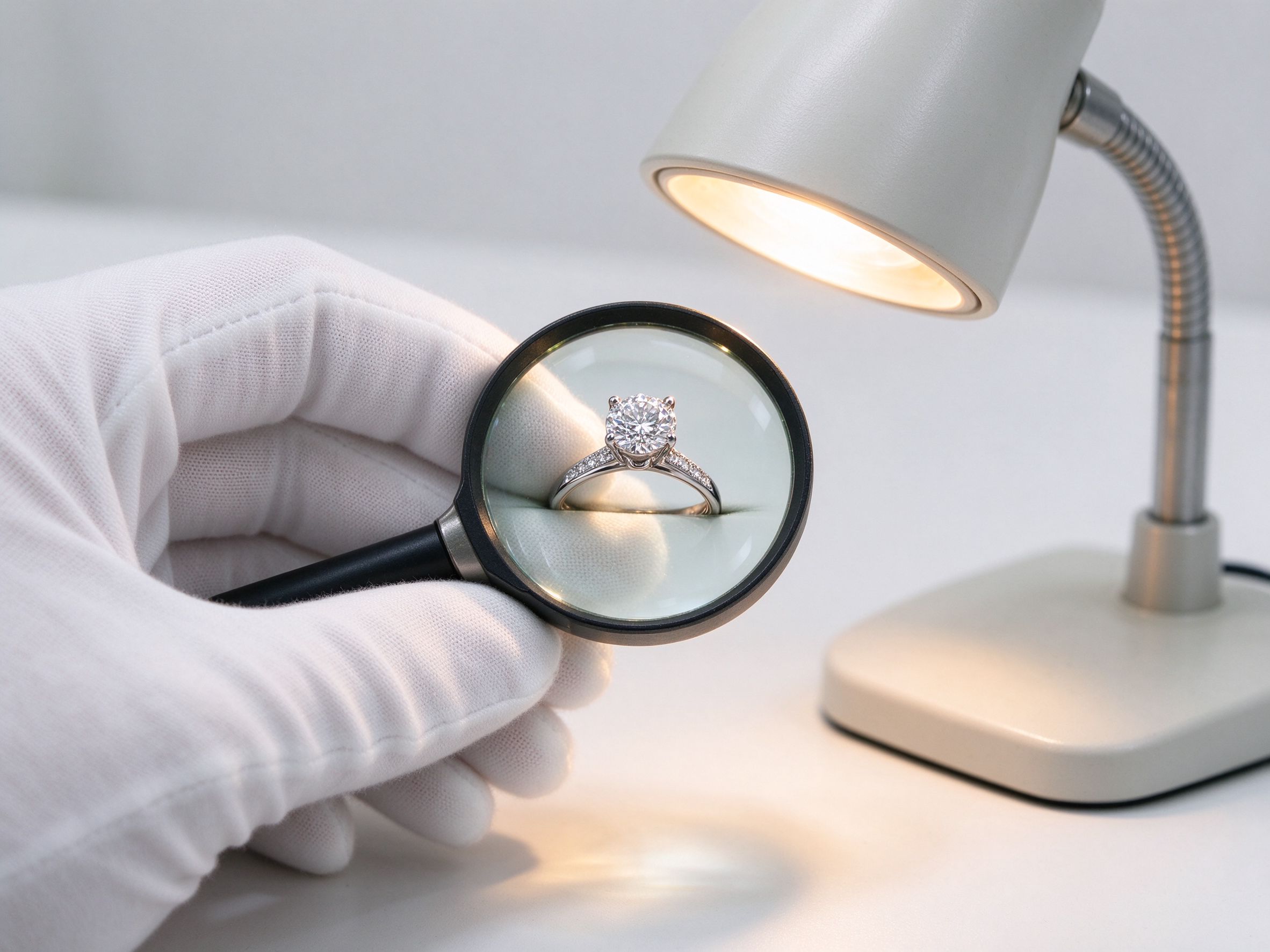
Why Moissanite Clarity Is Different from Diamond Clarity
In natural diamonds, clarity grading is critical because diamonds form under extreme geological conditions over billions of years. They contain inclusions, fractures, and mineral crystals trapped inside. The clarity grade determines how visible these internal characteristics are, and it has a major impact on price.
Moissanite clarity works differently. Because moissanite is lab-grown in a controlled environment, the growth process is far cleaner than natural diamond formation. There are no geological contaminants trapped inside. The result is that the vast majority of commercial moissanite is VVS grade by default. Inclusions are rare, and when they occur, they are usually growth lines or tiny crystals near the girdle that are not visible to the naked eye.
This does not mean clarity does not matter. It means the clarity discussion in moissanite is narrower. You are choosing between VVS1, VVS2, and occasionally VS1. You are not choosing between IF and I3 the way you would with diamonds.
The Clarity Scale for Moissanite
Moissanite uses the same clarity grading nomenclature as diamonds, but applied to a cleaner material:
- VVS1 (Very Very Slightly Included): Inclusions are extremely difficult to see under 10x magnification. For practical purposes, the stone appears flawless.
- VVS2 (Very Very Slightly Included): Inclusions are very difficult but not impossible to see under 10x. Still eye-clean from every angle.
- VS1 (Very Slightly Included): Inclusions are visible under 10x but not visible to the naked eye. Usually small crystals or clouds near the pavilion.
- VS2 (Very Slightly Included): Inclusions are easier to see under magnification. Still eye-clean in most cases, but may be visible when the stone is face-up under bright light.
At HOLYCOME, our standard stock is VVS1 and VVS2. VS stones are available on request at a lower price. We rarely see SI or I grade moissanite in commercial production, because the growth process naturally produces clean crystals.
What Inclusions Look Like in Moissanite
When moissanite inclusions do occur, they look different from diamond inclusions. The most common types are:
- Growth lines: Subtle parallel lines that reflect the crystal growth process. Usually near the girdle or pavilion. They look like faint striations.
- Metal droplets: Tiny specks of residual metal from the growth crucible. Usually microscopic and positioned near the culet.
- Clouds: Tiny clusters of micro-inclusions that create a slightly hazy area. More common in lower-grade stones.
- Feathers: Internal fractures, usually caused by stress during cooling. Rare in modern production.
None of these inclusions affect the structural integrity of the stone. Moissanite is hard and tough regardless of clarity grade. The clarity grade is purely about appearance.
VVS1 vs VVS2: Is the Difference Worth Paying For?
For wholesale buyers, this is the key question. The price difference between VVS1 and VVS2 is typically 10 to 15 percent. Is it worth it?
For most jewelry applications, no. The difference between VVS1 and VVS2 is visible only under a jeweler's loupe at 10x magnification. Your customers will never see it. Even trained gemologists often cannot agree on whether a stone is VVS1 or VVS2 without careful examination.
We recommend buying VVS2 as your default. It offers the same eye-clean appearance as VVS1 at a lower cost. Reserve VVS1 for your premium line where you want to advertise the highest grade, or for stones above 3 carats where inclusions become slightly more visible.
When VS Grade Makes Sense
VS grade moissanite is cheaper, sometimes by 20 to 30 percent. When is it a good choice?
VS makes sense when the stone will be set in jewelry that hides the inclusions. For example, an emerald-cut stone set in a bezel setting, where the edge is covered by metal, will not show VS inclusions near the girdle. Similarly, small accent stones under 3mm are too small for inclusions to matter.
VS is also a good choice for fashion jewelry where price sensitivity is high and customers do not expect top-tier grading. If you are selling a $99 fashion ring, a VS stone is perfectly adequate.
VS is not a good choice for solitaire engagement rings where the stone is exposed and customers expect VVS. If you sell VS stones as VVS, you will get returns.
How to Inspect Clarity Yourself
Every wholesale buyer should own a 10x jeweler's loupe. Here is how to inspect clarity:
- Hold the stone by the girdle with tweezers under a bright light.
- Look through the table (the large flat top facet) first. Scan for dark spots, clouds, or fractures.
- Tilt the stone and look through the pavilion. Inclusions often appear more visible from this angle.
- Check around the culet and girdle edges. These are the most common inclusion locations.
- Compare the stone to a known VVS benchmark. If you cannot tell the difference, the stone is VVS grade.
If you do not have a loupe, a phone camera macro lens can work as a poor substitute. But a real loupe costs under $20 and is the most useful tool in your quality control kit.
Clarity and Resale Value
One consideration that wholesale buyers sometimes overlook is resale value. While moissanite does not hold resale value the way diamonds do, a VVS stone will photograph better and display better in your marketing. In the online world, where customers judge stones by photos, clarity translates directly to perceived quality. A VVS stone photographs cleaner. A VS stone may show a cloudy area in macro photography that costs you sales.
For this reason, we recommend photographing your stones yourself rather than relying on factory photos. What looks fine in hand may not look fine on screen.