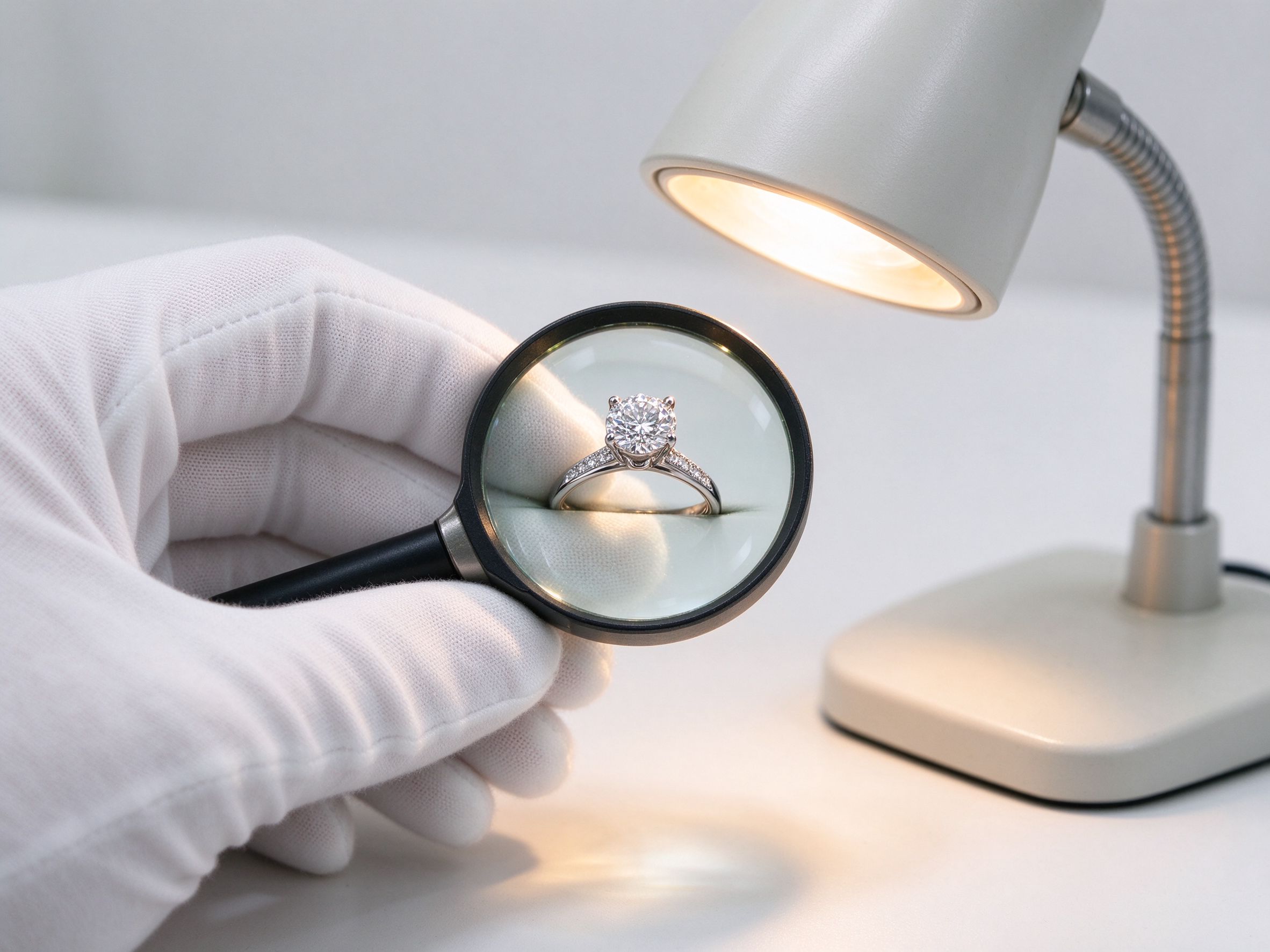
Why QC Is Your Competitive Advantage
In the moissanite wholesale business, every factory can cut a stone. What differentiates a good factory from a great one is consistent quality. Buyers do not switch suppliers because the price is 5 percent lower. They switch because the quality is inconsistent. A strict QC process is your best retention tool.
This guide describes the QC workflow at HOLYCOME. Use it as a benchmark for evaluating your own supplier, or as a template if you are building your own QC process.
Step 1: Incoming Material Inspection
The QC process starts before cutting. When moissanite boules arrive from the crystal growth supplier, we inspect them for:
- Color consistency: no visible yellow or green zoning.
- Clarity: no large internal fractures or dark clouds.
- Size: boule diameter matches the order.
Boules that fail this inspection are returned to the crystal supplier. We do not cut inferior material.
Step 2: Cutting and Polishing
After the boule is cut into gemstone shapes, each stone goes through a first inspection. The cutter checks:
- Symmetry: the shape is balanced and matches the template.
- No chipping on girdle or corners.
- Facets are polished cleanly, no burn marks.
Stones that fail are re-polished or discarded.
Step 3: Visual Grading
The stones then go to a grading bench. Under controlled 5500K lighting, a trained grader evaluates:
- Color: compared to master color stones (D, E, F).
- Clarity: under 10x loupe, looking for inclusions.
- Cut performance: face-up brightness, fire, and bow-tie in fancy shapes.
Stones are sorted into grades. Only VVS and E-F color stones go into our standard stock.
Step 4: Certificate Matching
For stones that come with GRA certificates, we verify:
- The certificate number matches the laser inscription on the girdle.
- The measurements on the certificate match the actual stone.
- The color and clarity grade matches our visual grading.
If there is a mismatch, the certificate is rejected and a new one is issued, or the stone is downgraded.
Step 5: Pre-Shipment Photo Approval
Before bulk orders ship, we send photos of every stone to the buyer. The photos show each stone in hand, with the order number written on a slip of paper beside it. The buyer confirms approval before we ship.
This step eliminates disputes. The buyer sees exactly what they are getting. If they want a different stone, we swap it before shipment.
Step 6: Final Packaging Check
Before sealing the carton, we count the stones against the packing list. We verify that every stone is in its labeled box. We check the shipping address and declared value. Only then does the package go to the courier.
This six-step process takes time, but it produces a near-zero defect rate. Our return rate for quality reasons is under 2 percent.
Common QC Failure Examples and How to Catch Them
After years of QC, we have seen every type of defect. Here are the most common ones and how to spot them:
- Girdle chips: Tiny nicks on the edge of the stone. Visible under 10x loupe. Usually caused by rough handling during packaging. Catch by inspecting the girdle edge under magnification.
- Bow-tie in ovals: Dark shadow across the center. Visible to the naked eye under bright light. Catch by face-up inspection under a lightbox.
- Color mismatch: A stone labeled D that looks yellow. Catch by comparing to a master D-color stone on a white surface.
- Measurement discrepancy: A stone labeled 6.5mm that measures 6.4mm. Catch with a digital caliper.
- Facet misalignment: Facets that do not line up symmetrically. Catch by face-up visual inspection.
These defects are rare in our production, but they exist. The QC process exists to catch them before they reach the customer. A 2 percent defect rate is normal and acceptable. Anything above 5 percent indicates a production problem that needs fixing.
How to Train Your Own QC Staff
If you are a buyer receiving bulk shipments, you need your own QC process. You do not need a gemologist. You need a trained person with a loupe and a checklist.
Training takes about a week. Day 1: learn to identify the common defects. Day 2: practice inspecting known good and known bad stones. Day 3: inspect 20 stones independently and compare results. By day 5, the inspector should be consistent.
Give your inspector a simple checklist for each stone:
- Size matches order? (caliper)
- Color matches sample? (white paper comparison)
- Any visible inclusions? (loupe scan)
- Any chips on girdle or corners? (loupe scan)
- Bow-tie acceptable? (face-up light test)
- Certificate matches stone? (laser inscription check)
If any answer is no, set the stone aside as rejected. Keep a log of rejects. If the rejection rate exceeds 5 percent, contact your supplier.
When to Reject an Entire Shipment
Most QC issues are individual stones that can be replaced. But sometimes an entire shipment is substandard. Reject the whole shipment if:
- More than 10 percent of stones have the same defect (e.g., all ovals have strong bow-tie).
- The color is consistently lower than the approved sample (e.g., all stones are F when you ordered D).
- The cut quality is visibly worse than the sample you approved.
- Certificates do not match the stones.
When you reject a shipment, take photos of the problems and send them to your supplier. A reputable supplier will either re-cut the stones or send a replacement batch. If the supplier argues, you have the photos as evidence. Do not accept a substandard shipment just to save time. The stones will come back as returns from your customers.
Frequently Asked Questions: QC Process
Q: What rejection rate is normal? A: Under 5 percent. If you are consistently rejecting more than 5 percent, talk to your supplier. The production process needs adjustment.
Q: Do I need a gemologist to inspect stones? A: No. A trained person with a $20 loupe and a checklist can catch 95 percent of defects. You only need a gemologist for disputed grading.
Q: What should I do if I find a defective stone? A: Set it aside. Photograph it. Note it on your receiving log. At the end of the shipment, report all defects to your supplier and request replacements.
Q: Should I inspect every stone? A: Yes, every stone. It takes 30 seconds per stone. For a 50-piece order, that is 25 minutes. It is worth it.
Q: Can I trust factory photos? A: Use them as a reference, but always inspect the physical stones. Photos can hide defects or flatter mediocre cuts. The physical stone is the truth.
Building Your In-House QC Checklist
If you receive bulk moissanite shipments, you need your own QC process. Here is a simple checklist that takes 30 seconds per stone:
- Size check: Measure with a caliper. Does it match the order and certificate?
- Color check: Place on white paper under daylight. Does it match the approved sample?
- Clarity check: Scan with a 10x loupe. Any visible inclusions, chips, or cracks?
- Cut check: Look face-up under bright light. Is it bright and lively? Any dark areas?
- Bow-tie check: For ovals, pears, and marquise. Any permanent dark shadow?
- Certificate check: Does the girdle inscription match the certificate number?
Record each stone on a receiving log. Mark pass or fail. At the end of inspection, calculate your rejection rate. If it exceeds 5 percent, contact your supplier with photos. Most good suppliers will replace defective stones at no charge.
Do not skip QC to save time. A defective stone that reaches a retail customer costs you far more than 30 seconds of inspection. One bad review costs hundreds of future sales.
Real QC Failure: The 3-Percent Defect Batch
Here is a real QC incident from our own production line. In February 2026, we produced a batch of 200 oval stones. During our internal QC, we found that 6 stones (3 percent) had stronger-than-expected bow-tie effects. These were not visible at our normal inspection distance. They only showed up when we held the stones under a specific angled light.
Our normal rejection rate is under 2 percent. At 3 percent, this batch was borderline. We had two choices: ship the stones with a disclaimer, or re-cut them. We chose to set the 6 stones aside as "stock clearance" and replace them from our reserve stock. The 194 clean stones went to the buyer. The 6 flagged stones were sold at a 40 percent discount to a customer who accepted the bow-tie.
The cost of this decision: 6 stones at $48 each = $288 in lost margin. But the buyer received 194 excellent stones and reordered. The 6 clearance stones recovered $173. Net cost: $115. This is the cost of quality control.
We also investigated why the bow-tie appeared. The cutting machine had a slightly misaligned angle on that day. We recalibrated. The next batch was back to 1 percent rejection rate.
The lesson for buyers: when a factory tells you their rejection rate is under 2 percent, ask what they do with rejected stones. A factory that sells rejected stones as first-quality is one to avoid. A factory that separates and discounts its rejects is honest. We publish our rejection rate on request.
Key Takeaways
Quality control is your competitive advantage. Every factory can cut a stone. The difference between a good supplier and a bad one is consistent quality. A strict QC process that rejects 2 to 5 percent of production protects your brand and your customers.
Inspect every stone. Size it with a caliper. Check color on white paper. Scan with a loupe. Look face-up under bright light. Verify the certificate. It takes 30 seconds per stone. For a 50-piece order, that is 25 minutes. It is worth it. A single defective stone reaching a customer costs more than 25 minutes of inspection.
If your rejection rate exceeds 5 percent, stop and talk to your supplier. A good factory will acknowledge the problem and send replacements. A bad factory will argue. Document everything with photos. When in doubt, reject the shipment. The cost of a short delay is less than the cost of a bad review. QC is not a cost center. It is a marketing expense that protects your reputation.
Your QC process is not bureaucracy. It is how you build a reputation. A customer who receives a perfect stone every time becomes a customer for life. A customer who receives one chipped stone may never come back. The 30 seconds you spend inspecting is the cheapest marketing you will ever buy.
If you are a buyer receiving our stones, our QC process is your guarantee. Every stone has been inspected before it ships. But we encourage you to inspect again on arrival. Two sets of eyes are better than one. If you find anything, tell us. We fix it.
Good QC also means honest communication. If a stone is not perfect, say so. Do not ship it and hope the customer does not notice. A short email saying "this stone has a tiny inclusion near the girdle, we discounted it 10 percent" builds more trust than a surprise after delivery.