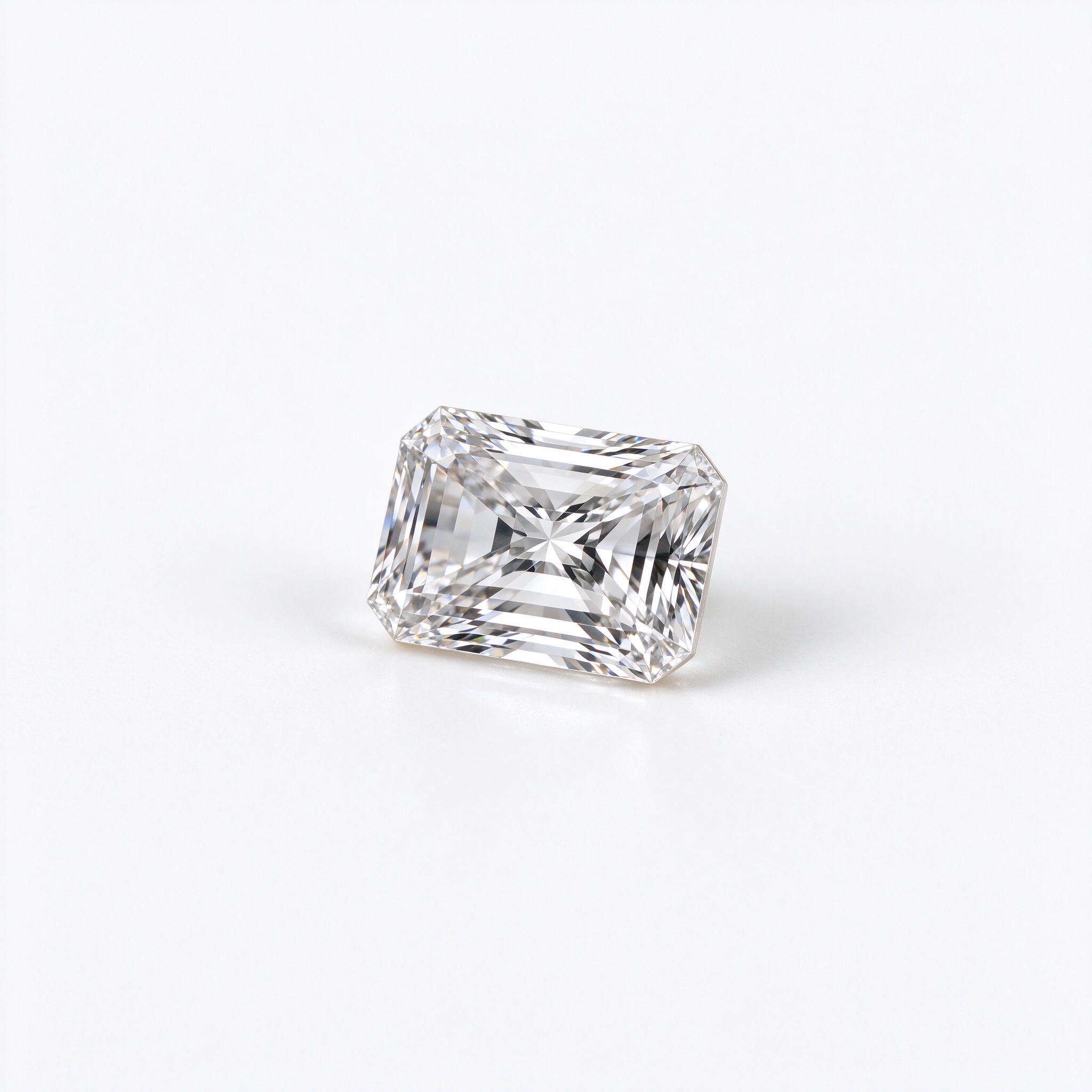
The Step Cut Philosophy
Most gem cuts (round, oval, princess) are brilliant cuts designed to maximize sparkle. The emerald cut is different. It is a step cut, characterized by long, parallel facets that look like a staircase when viewed from above. Instead of a burst of tiny sparkles, the emerald cut produces a calm, mirror-like reflection.
This look is often described as "ice" or "hall of mirrors." It is understated, architectural, and sophisticated. Customers who choose emerald cut typically prefer a quiet luxury look over maximum sparkle. They want a stone that looks expensive, not flashy.
Anatomy of an Emerald Cut
An emerald cut is a rectangular or square shape with clipped corners. The top surface (table) is large, surrounded by concentric rows of parallel facets called steps. The pavilion also has step facets that slope inward.
The length-to-width ratio is a key design choice:
- 1.30:1 to 1.50:1: The classic emerald cut rectangle. This is the most popular proportion.
- 1.00:1 (square emerald): Called an Asscher-style or square emerald. More compact and modern.
- 1.60:1 and above: Very long and narrow. A fashion-forward look that is polarizing.
Why Clarity Matters More in Emerald Cut
Because step cuts have large, open facets, internal inclusions are far more visible than in brilliant cuts. In a round brilliant, tiny inclusions are hidden by the chaos of reflected light. In an emerald cut, they show clearly through the mirror-like facets.
This means when you buy emerald cut moissanite, you should insist on VVS clarity. VS or lower-grade stones will show visible inclusions that customers will notice. At HOLYCOME, all our emerald cut moissanite is VVS.
The open table also means color is more visible. An emerald cut in E-F color will look whiter than an oval in the same grade, because the large table shows the true body color directly.
Emerald Cut Moissanite: The Water Crack Effect
One characteristic of emerald cut moissanite is what gemologists call the "water crack" or "glass effect." Because moissanite is doubly refractive, the step facets can show a slight doubling or refraction pattern when viewed from certain angles. This is normal and not a defect. However, it can make the stone look like colored glass to an untrained eye.
For this reason, emerald cut moissanite is best sold to customers who appreciate the step-cut look and understand that it is not meant to look like a brilliant-cut diamond. Market it as a sophisticated, architectural choice, not as a diamond substitute.
Best Settings for Emerald Cut
Emerald cut stones look best in settings that complement their clean lines:
- Bezel setting: A thin metal border around the stone emphasizes the rectangular shape and protects the corners.
- Four-prong solitaire: Simple prongs at the corners let the stone speak for itself. This is the classic look.
- Hidden halo: A thin halo of small stones underneath adds sparkle without disrupting the clean top view.
- East-west setting: Setting the rectangle horizontally is a modern, fashion-forward choice.
Emerald Cut Sizes to Stock
Popular emerald cut sizes:
- 5x7mm (0.5ct equivalent) - small pendants, right-hand rings
- 6x8mm (0.9ct equivalent) - entry engagement rings
- 7x9mm (1.5ct equivalent) - our best-selling emerald size
- 8x10mm (2ct equivalent) - statement rings
Emerald cut sells more slowly than round or oval. Stock moderately and let demand guide reorders. It is a shape that attracts a specific customer, not a broad audience.
The Step-Cut Optical Philosophy
To understand the emerald cut, you must first understand why it looks so different from a brilliant cut. Brilliant cuts are designed to scatter light into tiny, sparkling points. Step cuts are designed to reflect light in broad, mirror-like planes. The long, parallel facets act like the steps of a staircase, reflecting light in wide bands rather than tiny flashes.
This optical approach is not inferior. It is simply different. A well-cut emerald moissanite has a calm, sophisticated appearance that reads as quiet luxury. It does not shout. It does not try to out-sparkle a round. Instead, it offers a clean, architectural beauty that appeals to customers who prefer understated elegance.
The large open table of an emerald cut also means the stone's color is displayed more honestly. In a brilliant cut, the constant reflection and refraction can mask slight color variations. In an emerald cut, what you see is what you get. This is why we insist on VVS clarity and E-F color for our emerald cut moissanite. Any imperfection is visible.
Because moissanite is doubly refractive, emerald cut moissanite shows a subtle "glassiness" under certain lighting. This is not a defect. It is the optical nature of the material. Some customers love this look; others prefer the more diamond-like appearance of a brilliant cut. Market emerald cut moissanite to customers who specifically want the step-cut look, not as a general-purpose stone.
Metal Settings for Emerald Cut Moissanite
The clean lines of the emerald cut pair best with settings that do not compete with the stone's geometry:
- Bezel setting: A thin metal border around the rectangle emphasizes the clean outline. Bezel settings also protect the corners, which are vulnerable in emerald cuts. This is our recommended setting for emerald cut moissanite.
- Four-corner prong solitaire: Prongs at the four clipped corners hold the stone securely. This is a classic look that lets the stone's shape speak for itself. Choose platinum or white gold for a modern feel.
- Hidden halo: A thin halo of small round stones underneath adds sparkle without disrupting the clean top view. This is a popular option for customers who want some extra brilliance.
- East-west setting: Setting the rectangle horizontally is a bold, modern choice. It works particularly well on wider bands and makes the ring look substantial.
For emerald cut, we recommend white gold or platinum. The cool metal complements the stone's clean, architectural look. Yellow gold emerald cut rings have a vintage art-deco appeal but are less common. Rose gold emerald cuts are a niche fashion choice.
Common Emerald Cut Buying Mistakes
The first mistake is buying an emerald cut with low clarity. As we emphasized, step cuts show inclusions more clearly. If you buy VS or SI emerald cut moissanite, your customers will see internal flaws. Always insist on VVS for emerald cuts. The slight price premium is non-negotiable.
The second mistake is buying an emerald cut that is too shallow. A shallow emerald cut looks dark and lifeless. Inspect the stone face-up under bright light. It should look bright and reflective across the entire surface. If it looks dull or dark, the cut is poor.
The third mistake is overstocking emerald cuts. Emerald is the slowest-selling of the common shapes. It attracts a specific, design-focused customer. Stock 3 to 5 pieces of your best size and let demand guide reorders. Do not try to push emerald as a general-purpose shape.
The fourth mistake is comparing emerald moissanite to emerald diamond. Natural emeralds are soft and included. Moissanite emerald cuts are hard and clean. Customers who expect the "natural emerald" look may be surprised by how clear the moissanite version is. Set expectations clearly in your marketing.
The fifth mistake is ignoring the clipped corners. Emerald cuts have clipped corners, not sharp 90-degree angles. This is by design, to protect the corners from chipping. When ordering settings, make sure the jeweler knows the stone has clipped corners. A setting designed for a true rectangle will not fit correctly.
Frequently Asked Questions: Emerald Cut Moissanite
Q: Why do emerald cut stones look darker than brilliants? A: Step cuts reflect light in broad planes rather than tiny sparkles. This gives a calm, mirror-like appearance. It is not a defect; it is the design. If you want maximum sparkle, choose a brilliant cut.
Q: Do I need VVS clarity for emerald cut? A: Yes. The large open facets show inclusions clearly. Buy VVS only. VS stones will have visible internal characteristics that customers will notice.
Q: What does "glass effect" mean in emerald moissanite? A: Because moissanite is doubly refractive, step-cut moissanite can look like colored glass at certain angles. This is normal. It is not a defect. Market it to customers who want the step-cut look, not as a diamond substitute.
Q: What settings protect emerald cut corners? A: Bezel settings and four-corner prongs. The clipped corners are vulnerable. A bezel is the most protective option.
Q: Is emerald cut popular? A: It is a niche shape that appeals to design-focused buyers. It sells more slowly than round or oval but attracts customers who want something distinctive.