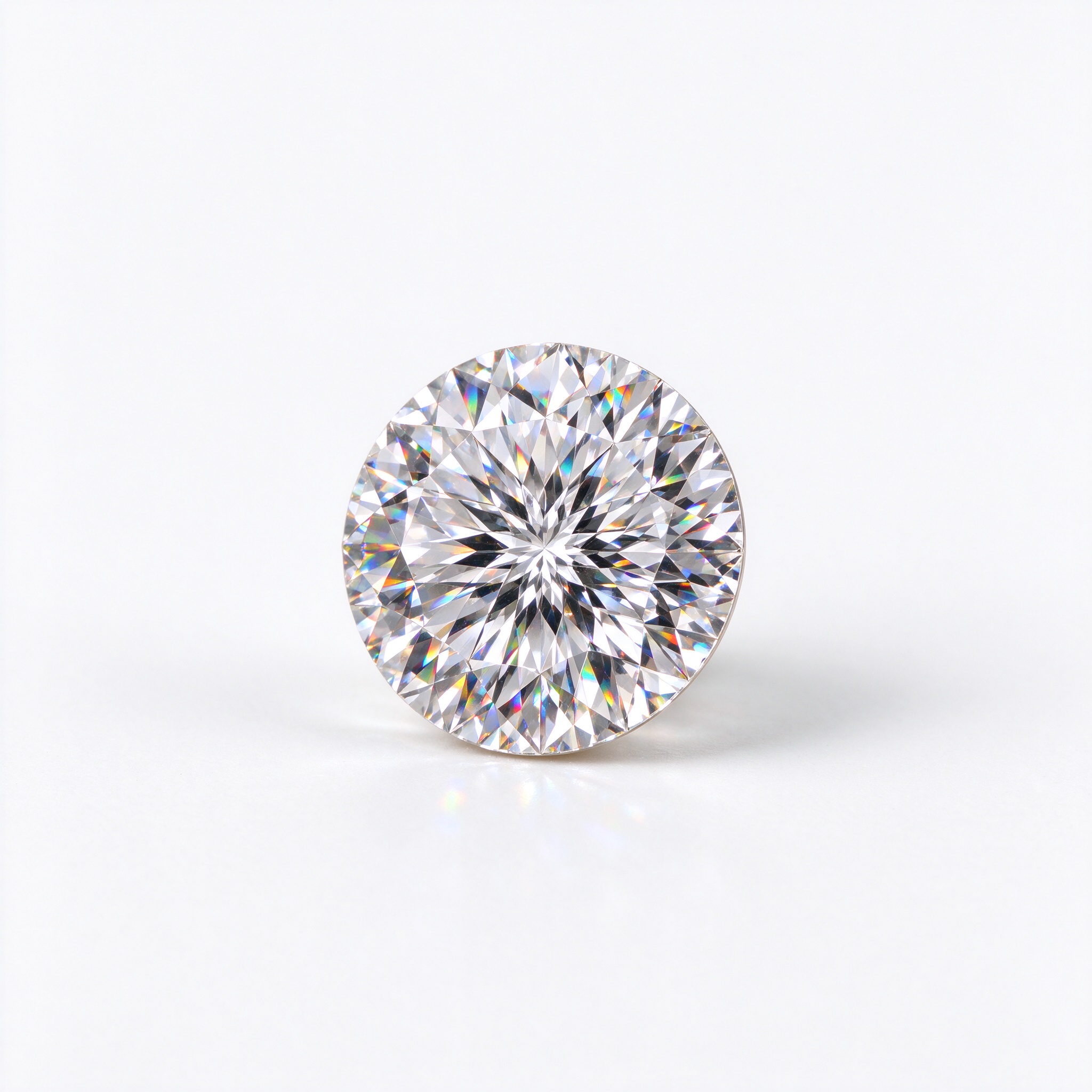
Why the Round Brilliant Dominates
More than 60 percent of all loose gemstones sold worldwide are round brilliant. This is not an accident. The round brilliant cut was engineered over a century ago to maximize light return. It is the most mathematically optimized cut in existence, and it works on every gem material, from diamond to moissanite to sapphire.
For wholesale buyers, the round brilliant is your safest SKU. It is the default shape for engagement rings, stud earrings, pendants, and tennis bracelets. If you only stock one shape, make it round.
The Anatomy of a Round Brilliant
A standard round brilliant has 57 facets (or 58 with a culet). The table below shows the facet layout:
- Table: The large flat facet on top. Typically 53 to 58 percent of the stone's diameter.
- Crown: The upper portion, consisting of 32 facets (8 star, 8 kite, 16 upper girdle). The crown angle is typically 34 to 35 degrees.
- Girdle: The thin edge around the middle. Usually thin to slightly thick.
- Pavilion: The lower portion, consisting of 24 facets (16 lower girdle, 8 main pavilion). The pavilion angle is typically 40.5 to 41 degrees.
- Culet: The small facet at the bottom point. Usually pointed or very small.
These proportions are not arbitrary. They are the result of decades of optical research. Get them right, and the stone returns nearly all light that enters. Get them wrong, and light leaks out the bottom or sides, making the stone look dark and glassy.
Ideal Cut Proportions for Moissanite
Because moissanite has a higher refractive index than diamond (2.65 vs 2.42), the ideal cut proportions are slightly different. At HOLYCOME, we cut our round moissanite to the following specifications:
- Table: 55 to 57 percent
- Crown angle: 34 to 35 degrees
- Pavilion angle: 40.5 to 41 degrees
- Total depth: 59 to 62 percent
- Girdle: Thin to medium
- Culet: Pointed
These proportions maximize the combination of brilliance and fire that moissanite is known for. A stone cut to these specs looks bright, lively, and well-proportioned from every angle.
Common Round Cut Defects to Avoid
Not all round cuts are equal. Here are the defects we look for during QC:
- Too deep: If the total depth exceeds 65 percent, the stone looks dark in the center. This is called a "nailhead" or "deep cut."
- Too shallow: If the depth is under 56 percent, light leaks out the bottom. The stone looks glassy and lifeless.
- Off-center table: If the table facet is not centered, the stone looks lopsided when viewed face-up.
- Thick girdle: An overly thick girdle makes the stone look heavy and reduces the visible size face-up.
- Uneven facets: Facets that are not aligned cause uneven light reflection. The stone looks "patchy."
Avoid factories that do not specify cut proportions. If they cannot tell you the table percentage and crown angle, they are cutting by eye, not by precision.
Why Round Is the Best-Selling Shape
Round brilliant outsells every other shape combined. The reasons are practical and emotional:
- Versatility: Round works in every setting style: solitaire, halo, pav, bezel, three-stone.
- Timelessness: Round has been the engagement ring standard for a century. It does not go out of style.
- Predictability: Customers know what a round stone should look like. They do not need to be educated.
- Maximum sparkle: The round cut optimizes light return better than any other shape.
- Easier setting: Jewelers prefer setting round stones because they are symmetrical and prong placement is straightforward.
For a new jewelry brand, starting with round stones is the lowest-risk path. Once you have established round sales, expand into fancy shapes.
Size Range and Inventory
At HOLYCOME, we stock round brilliant moissanite in the following sizes:
- 3mm (0.15ct equivalent) - accent stones, pav
- 4mm (0.25ct equivalent) - small studs, side stones
- 5mm (0.5ct equivalent) - studs, small pendants
- 6.5mm (1ct equivalent) - engagement rings, best seller
- 7mm (1.25ct equivalent) - slightly larger solitaire
- 8mm (2ct equivalent) - statement rings, pendants
- 9mm (3ct equivalent) - high-end pieces
- 10mm and above (4ct+) - custom orders
The 6.5mm and 8mm sizes are your volume sellers. Stock these deepest. The smaller sizes (3-5mm) are needed for bridal sets and accent jewelry. The larger sizes (9mm+) are special order.
The Optical Physics Behind the Round Brilliant
To understand why the round brilliant performs so well, it helps to understand what happens when light enters a stone. White light enters through the table and crown facets. Some of it reflects immediately off the crown (called white brilliance). The rest travels through the pavilion, where it either reflects back to the viewer (called internal reflection) or leaks out the bottom (called light leakage). The cutteru0027s job is to angle the pavilion so that nearly all light reflects back.
In a round brilliant, the pavilion angle of approximately 40.75 degrees creates a perfect critical angle for moissanite. At this angle, light that hits the pavilion facets undergoes total internal reflection and bounces back up through the table. This is why a well-cut round looks bright from every viewing angle. If the pavilion is even 2 degrees too shallow, light escapes out the bottom and the stone looks dark or glassy.
The crown angle of 34.5 degrees is equally important. It determines how much white light reflects off the top facets versus entering the stone. A slightly steeper crown increases fire (colored flashes) but reduces white brilliance. A shallower crown does the opposite. The 34.5-degree balance is the result of decades of optical research and is the reason the round brilliant has remained unchanged as the global standard for over a century.
Moissaniteu0027s higher refractive index (2.65 vs diamondu0027s 2.42) means it bends light more sharply. This is why the ideal pavilion angle for moissanite is slightly different from diamond. At HOLYCOME, we cut our moissanite rounds to 40.8 to 41.2 degrees, which is about 0.5 degrees deeper than the diamond ideal. This small adjustment is what makes our rounds look exceptionally bright and well-proportioned.
Which Metal Settings Best Complement a Round Moissanite
The metal you choose for a setting dramatically affects how the stone appears. For a round moissanite, each metal color creates a different look:
- Platinum: The most traditional and premium choice. Platinumu0027s cool white tone makes D and E color moissanite appear brightest. The weight of platinum also gives a ring a substantial, high-quality feel. Platinum is hypoallergenic and ideal for customers with metal sensitivities.
- White gold (14k or 18k): The most popular choice for bridal. White gold is rhodium-plated to look bright white, similar to platinum but at a lower price point. The rhodium plating wears off over 1 to 2 years and needs re-plating. Factor this into your after-sales service offering.
- Yellow gold: A warm, vintage look. Yellow gold complements F or G color moissanite, where the slight warmth of the stone blends harmoniously with the warm metal. Avoid pairing yellow gold with D-color stones, as the contrast can make the stone look slightly gray.
- Rose gold: A romantic, modern choice that pairs beautifully with E-F color moissanite. The pink warmth of rose gold softens the stoneu0027s bright fire. Rose gold engagement rings are one of the fastest-growing trends in bridal jewelry.
When buying round moissanite for a specific setting, match the color grade to the metal. D and E stones for white metals. F and G stones for yellow and rose gold. This simple matching reduces cost while optimizing appearance.
Common Wholesale Buying Mistakes with Round Stones
After supplying hundreds of jewelry brands, we see the same mistakes repeated with round moissanite. The first is buying only one size. New buyers stock 6.5mm rounds and forget that customers also want 5mm studs, 7mm mid-size rings, and 8mm statement pieces. Plan for at least four size steps in your round inventory.
The second mistake is overpaying for VVS1 when VVS2 is indistinguishable. The 10 to 15 percent price premium for VVS1 is not justified for commercial jewelry. Your customers will never see the difference under normal viewing conditions. Save that margin and buy VVS2 as your default.
The third mistake is ignoring cut consistency across batches. One factory may produce excellent rounds one month and mediocre rounds the next. This is why you should always inspect every shipment, not just the first one. Build a benchmark stone from your best order and compare every new shipment against it. If a new batch looks duller or darker than the benchmark, send it back.
The fourth mistake is buying uncertified stones for engagement rings. Even though moissanite is affordable, customers expect documentation for engagement-ring purchases. Include a GRA certificate on every 6.5mm and larger stone sold as a center stone. The $3 to $8 cost per certificate builds trust and justifies a higher retail price.
The fifth mistake is buying too deep or too shallow rounds to save money. Factories sometimes sell poorly cut stones at a discount. A deep-cut round looks dark in the center. A shallow-cut round looks glassy and lifeless. Insist on the cut proportions we listed earlier, and reject stones that fall outside the range.
Frequently Asked Questions: Round Brilliant Moissanite
Q: Is a 6.5mm round moissanite the same size as a 1-carat diamond? A: In diameter, yes. A 6.5mm round moissanite is the visual equivalent of a 1-carat diamond. Because moissanite is less dense, its actual carat weight is lower (about 0.9 carats), but the face-up size is identical. Customers will perceive it as a 1-carat stone.
Q: Can a jeweler set moissanite with standard diamond tools? A: Yes. Moissanite is hard enough to withstand standard jewelry setting. Prongs can be bent, soldering can happen nearby, and the stone can be polished. Your bench jewelers will not need specialized training.
Q: Does round moissanite ever look yellow? A: In D or E color, no. In F color, a very slight warmth may appear in side-by-side comparison with a D stone, but it is not noticeable on its own. If a stone looks yellow, it has been misgraded.
Q: What is the minimum order for round stones? A: At HOLYCOME, our sample order starts at 5 pieces. Bulk orders start at 10 pieces per size. We offer tiered pricing at 50 and 100 pieces.
Q: How long does it take to receive a round stone order? A: Stock sizes (6.5mm, 8mm) ship within 3 to 5 days. Custom or less common sizes take 7 to 15 days. International shipping adds 3 to 7 days via DHL.