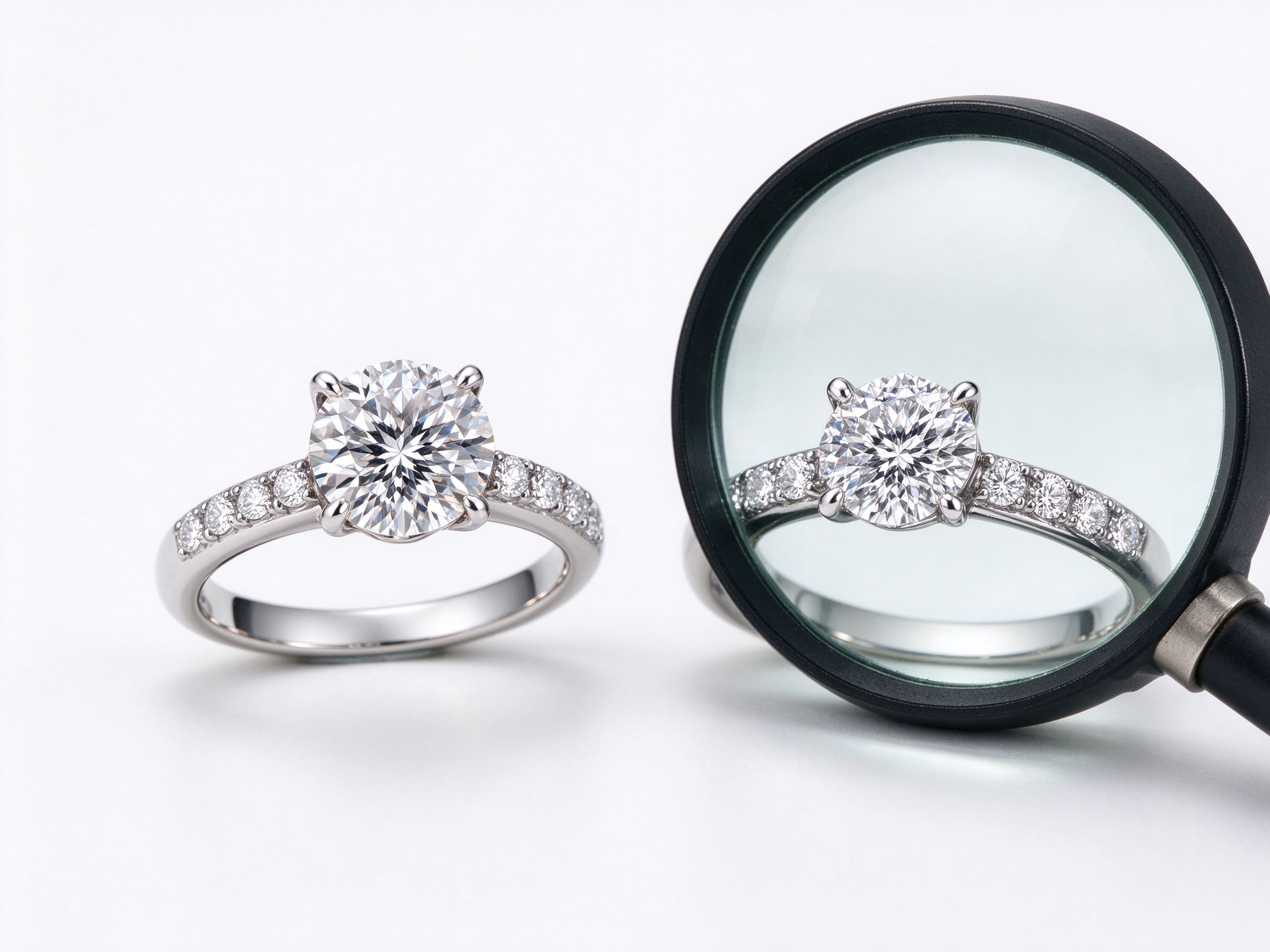
Why Color Matters More in Moissanite Than You Think
Moissanite's strong fire and brilliance can actually make color more noticeable than in diamonds. Because the stone splits light into rainbow colors, a slight yellow or gray tint becomes more apparent against that colorful backdrop. This is why buying the right color grade is critical for a premium product.
Wholesale moissanite color grading follows the same D-to-Z scale as diamonds, but the visual thresholds are different. In moissanite, D and E are essentially colorless. F shows the faintest warmth. G and below become noticeably tinted.
Breaking Down D, E, and F Color
D Color: The Absolute Top
D-color moissanite is completely colorless, face-up and edge-on. It is the whitest, brightest stone available. D-color is the grade you want for platinum and white gold settings, where any warmth will be visible against the cool metal.
D-color commands a 15 to 25 percent price premium over E-F. For most buyers, this premium is not justified unless you are selling a premium brand or targeting customers who specifically request "colorless."
E Color: The Near-Colorless Sweet Spot
E-color moissanite is nearly colorless. The warmth is detectable only when you compare it side-by-side with a D stone, and only when viewed edge-on. Face-up, E-color looks identical to D to all but the most trained eye.
E-color is our recommendation for most wholesale buyers. It offers the whitest appearance at a price that preserves margin. At HOLYCOME, E-color is our best-selling grade.
F Color: The Budget-Friendly Choice
F-color moissanite shows a very slight warmth. It is not yellow by any means, but under bright daylight, a practiced eye can detect a soft tint. F-color is an excellent choice for rose gold and yellow gold settings, where the warm metal complements the stone's slight warmth.
F-color typically costs 10 to 15 percent less than E-color. If you are selling into the rose gold bridal trend, F-color is a smart cost saving that customers will not notice.
Color in Different Metal Settings
The metal you set the stone in dramatically affects how the color grade appears:
- Platinum and white gold: Cool, white metal makes any warmth in the stone obvious. Use D or E color for these settings.
- Yellow gold: Warm metal hides slight warmth in the stone. F or even G color works well. The stone and metal blend into a harmonious warm look.
- Rose gold: Pink-warm metal pairs beautifully with F or G color. The stone appears warm and romantic rather than "off."
When buying stones for a specific jewelry line, match the color grade to the metal. This is a simple way to reduce cost without compromising appearance.
The Yellow Tint Problem in Cheap Moissanite
Not all "D-color" moissanite is truly D-color. Some factories label lower-grade stones as D to command a higher price. Here is how to spot a yellow-tinted stone:
- Place the stone on a sheet of pure white paper under daylight. Look straight down at the table. A true D/E stone will look white. A tinted stone will show yellow or gray.
- Compare the stone edge-on. Hold it with tweezers and look through the thin edge. This is where color is most visible.
- Compare it to a known D-color benchmark. If your sample looks yellow next to the benchmark, it is not D.
This is why sample orders matter. Photos cannot reliably show color. You need the physical stone.
Treated vs Untreated Color
Some moissanite on the market is treated to improve its color. A lower-grade stone might be irradiated or heat-treated to remove yellow or green tint. Treated stones are generally stable and safe, but they should be disclosed to customers. The FTC requires disclosure of any treatment that affects value or durability.
At HOLYCOME, our standard D and E color stones are untreated. The color is a natural result of the growth process. We do not irradiate or heat-treat our standard stock. If you need treated fancy colors (such as black or green moissanite), we can source those separately and will disclose the treatment.
Color and Photography
Color is extremely difficult to photograph accurately. White balance, lighting temperature, and background all change how a stone appears online. For your product photography:
- Use a neutral gray or white background.
- Shoot in natural daylight or a 5500K softbox.
- Do not oversaturate the photo. Moissanite's fire is colorful enough; adding saturation makes it look fake.
- Include a size reference coin or ruler in one photo so customers understand scale.
Remember that your customers will compare your photos to other listings. If your photos show a whiter stone than they receive, you will get returns. Honest photography protects your reputation.