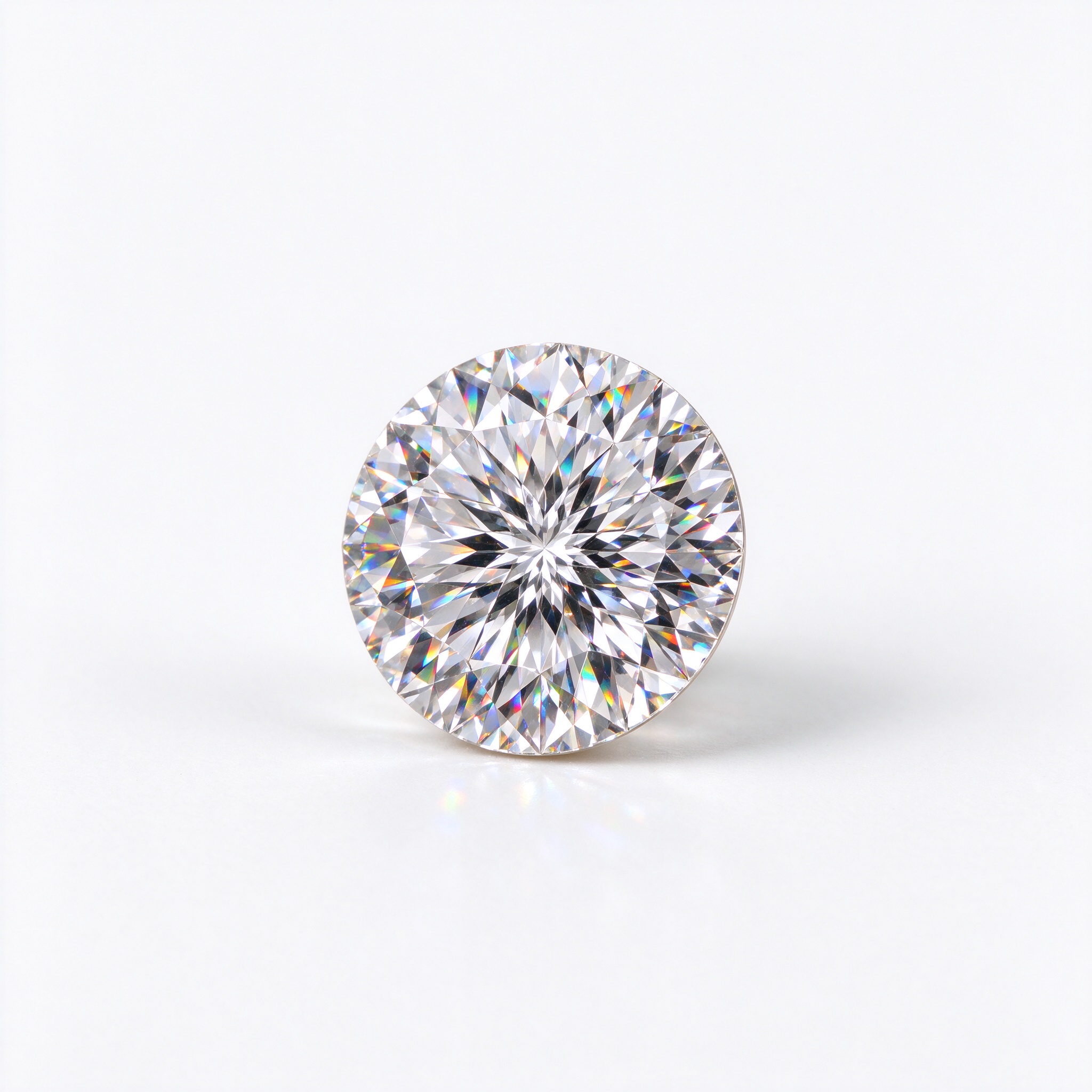
The round brilliant is the shape every other cut is compared against, and at our Wuzhou factory it is also the shape we cut more of than any other. Yet when new buyers ask us "why does one round brilliant moissanite look dead and another looks electric?" the answer almost never comes down to the stone itself. It comes down to proportions. In this guide we explain the numbers our cutters actually use, so you can judge a round moissanite on the bench instead of trusting a certificate at face value.
Why the round brilliant is a proportion problem
A round brilliant has 57 or 58 facets arranged in precise layers: a flat table on top, a ring of star and bezel facets, then upper and lower girdle facets, and a pavilion that tapers to the culet. Light enters through the crown, bounces off the pavilion facets, and must escape back through the top to your eye. If the pavilion is too shallow, light leaks out the bottom. If it is too deep, light leaks out the side. Either way the stone looks dark or glassy instead of bright.
Moissanite has a higher refractive index than diamond, so it actually bends light more sharply. That means proportion errors are punished harder than they would be on a diamond. A slightly off round moissanite can look obviously dull, while the same mistake on a diamond might pass. This is why we cut to ideal, not "good enough".
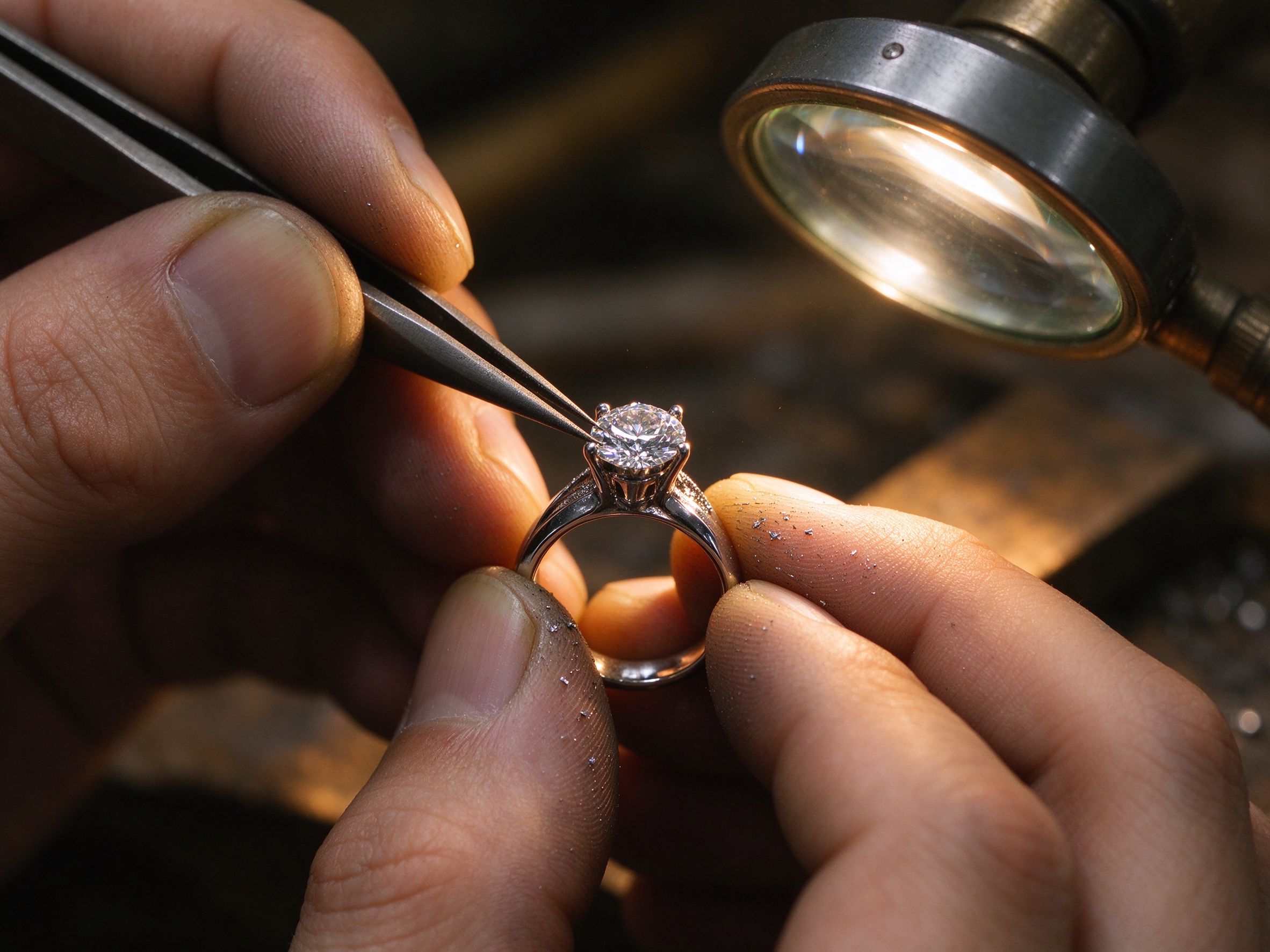
The four numbers that matter
Table percentage
The table is the large octagonal facet on the very top. On an ideal round brilliant it takes up roughly 56 to 62 percent of the total diameter. A larger table reads broader and calmer; a smaller table throws more tiny sparkle. For moissanite we usually target the middle of that range, around 58 percent, because it balances brilliance and fire without looking either flat or busy.
Total depth percentage
Total depth is the height of the stone divided by its width. For a round, the sweet spot is 59 to 63 percent. Below 58 percent the pavilion is too shallow and you get a see-through, "fish-eye" look around the girdle. Above 65 percent the stone looks sunk and dark. When we quote mm sizes for settings, depth matters because a deep stone will not sit flush in a low bezel.
Crown angle
The crown is the section between the table and the girdle. An ideal crown angle sits around 34 to 35 degrees. A steeper crown increases fire (the rainbow flashes) but can reduce overall brightness; a shallower crown increases size-up-face-up but softens the sparkle. For moissanite's high fire we keep the crown close to ideal so the stone looks balanced under both daylight and indoor light.
Pavilion angle
The pavilion angle is the most critical number of all. It should land near 40.5 to 41 degrees. This is the angle that bounces light cleanly back to the viewer. Drop below 40 degrees and you start to see the dark center; push above 42 degrees and the stone looks heavy. This is the first thing our QC team measures under the proportions scope, before any clarity check.
How we verify cut at the factory
When a rough silicon carbide crystal arrives, we map it for yield, then dop it and cut it in stages. After the main facets are in, we measure the table, girdle thickness, crown and pavilion angles on a precision scope. Only stones that fall inside our ideal window move on to polishing and inspection. Stones that fall outside are re-cut rather than shipped as "close enough". You can read more about this workflow in our deep dive on cut proportions and the bow-tie effect.
What this means for your buying decisions
If you are sourcing loose round brilliant moissanite for resale, ask your supplier for the actual table and depth percentages, not just a photo. A well-cut 1ct round at 6.5mm diameter should face up bright in a dark room when you tilt it. If it goes see-through or shows a dark center, the proportions are off regardless of what the certificate says. Browse our ideal-proportion round brilliant moissanite stones or ask us to cut a custom mm size through the custom cut inquiry page.
Common questions
Is a "hearts and arrows" round moissanite better? Hearts and arrows is a symmetry pattern visible under a scope, a nice bonus, but it is cosmetic. Brightness depends first on angles. We can cut hearts and arrows on request.
Does moissanite need different proportions than diamond? Because its refractive index is higher, it tolerates a slightly tighter window. We do not reuse diamond cut charts blindly; our scopes are calibrated for silicon carbide.
Will a well-cut round always look bigger? No. Face-up size depends on diameter in mm, which we list on every product page like our 1ct round brilliant stone. Proportions control sparkle, not size.
Reading a proportions report from our factory
When we ship a round brilliant, the certificate lists the key measurements, but the numbers only mean something if you know what to look for. The table percentage tells you how broad the top facet is. The depth percentage tells you whether the pavilion has enough room to bounce light. The girdle thickness tells you how much metal the prongs have to grip. A stone with an extremely thick girdle will look smaller than its carat suggests; an extremely thin girdle chips more easily. We target a medium to slightly thick girdle on every round, which balances durability and face-up size.
If you are a jeweler buying in volume, ask us to send the proportion sheet along with the stones. It costs us nothing to include, and it lets you sort stock by cut quality rather than by certificate label. Over time this builds a reputation: your customers notice that your rounds sparkle consistently, while competitors who bought "cheaper" rounds get returns on dull stones.
Why ideal cut matters more at wholesale
At retail, one poorly cut round might slip through. At wholesale, you are buying dozens or hundreds. A small proportion error multiplied across a whole batch becomes a returns problem. This is why we cut to ideal rather than shipping "near ideal" stock. The per-stone cost difference is tiny, but the consistency protects your brand. We explain this production logic in the QC process guide, and you can compare our stock on the round brilliant category page.
How light behaves in moissanite
Moissanite's refractive index of 2.65 is higher than diamond's 2.42, which means light bends more sharply inside the stone. The upside is exceptional fire and brilliance when the angles are right. The downside is that a badly cut moissanite looks worse than a badly cut diamond, because the bent light escapes more obviously. This is the technical reason we refuse to cut rounds to loose tolerances. We calibrate every scope and dop for silicon carbide, not diamond. For the optical comparison against diamond, read our fire and brilliance article.
The business case for ideal-proportion rounds
You might wonder whether paying for "ideal proportions" is worth it when a cheaper round looks fine in a product photo. The difference shows up in person. An ideal round returns light brilliantly in a dark room; a marginal round looks flat. For a jeweler, that difference is the difference between a customer who refers friends and one who returns the ring. We cut ideal because repeat business depends on it. Our wholesale price reflects that consistency, not a vague marketing label.
When you compare suppliers, ask each to send face-up videos of the same stone under a lamp. The ideal round will glow evenly across the whole table. The cheaper one will show dark edges. This ten-second check tells you more than any certificate. We send these videos on request because we are confident in our cuts.
What Wuzhou production means for consistency
We cut moissanite in Wuzhou, the center of the global moissanite trade. That means rough, scopes, polishers and QC are all in one workshop, so we control proportions from crystal to finished stone. It also means we can produce consistent batches: order ten 1ct rounds and they will all cut to the same window. This matters for retailers building a consistent line. Read more about our location in the Wuzhou article.